
You don’t need to know which Emergency tests you need. You do not need to know medical terminology. You are already having a bad day. However, understanding how the ER works can make your visit safer, faster, and less frustrating. Here are 10 tips that I hope can help.
The First Five
Number one: Don’t exaggerate your symptoms.
It is tempting to think that exaggerating your symptoms will make you take you more seriously.
Nothing could be further from the truth.
Think of it this way. If you genuinely had an Emergency medical condition, you would want us to get to the bottom of it quickly.
Additionally, other things to chase down in searching for the source of your life-threatening condition can prolong the workup. As a result, it costs valuable time in saving your life.
However, if you appear to have a low sense of urgency yourself, you may be taken less seriously. This will work against you. Therefore, please do not embellish or exaggerate your symptoms. Do not “pile on” symptoms to get more tests. Doing so makes your visit more difficult and time-consuming. Consequently, it will be more frustrating to you in the end.
Ten out of ten pain is the maximum. Ten is infinity, not a low bar to being taken seriously. Remember, the question is, “How bad is your pain?” not, “How seriously do you want to be taken?”
Tell us exactly what is going on. Don’t minimize, and don’t embellish.
Why Are You Really Here?
Number Two: Tell us why you’re really worried.
I can’t tell you how many times I’ve done an abdominal pain workup, and when it’s all said and done, the patient was actually worried they had cancer. If you tell me that up front, I can save you time on unnecessary tests. I can help guide you to better ways to figure that out. Don’t bury the headline. Remember, the eye-level headlines get more sales.
Try saying this: “The reason I came here today is because of…” Or, maybe word it as, “What I’m most worried about is…” The ER physician asking those questions can be delicate and may lead the patient to assume you think they don’t need to be there.
Number Three: Do not tailor your answers to steer the conversation toward a specific Emergency diagnosis or test. Quite honestly, an ER physician can better determine what tests are needed. This honesty also reduces unnecessary testing and saves time and resources. On the other hand, false information leads to extra testing and wasted time. Don’t forget, some tests cause harm. For example, CAT scans use radiation. Radiation can cause cancer. Thus, doctors should order the test when the risk of missing an urgent, life-threatening condition outweighs the risk of future cancer. An expert can decide by weighing the pros and cons. An expert can also decide by weighing the pros and cons. Finally, getting many tests that do not change your outcome is frustrating.
Emergency Patients Are Seen In Order Of Severity
Number Four: Watching others go ahead of you can be frustrating.
However, this is how Emergency Departments operate.
Think about it.
If you are very stable and a gunshot wound arrives, you do not get to go ahead.
Similarly, you would want the same courtesy if you were the gunshot wound patient.
The fact that you are waiting is a good sign.
It means you are not as sick as some patients in the department.
If your condition changes, we will reassess you.
When people from our community present with strokes, heart attacks, shock, bleeding, or severe trauma, we need to be ready.
We must care for them.
Be patient; we see everybody who comes in.
Number Five: Don’t expect everything to come back all at once. And, just as importantly, don’t expect the physician to act on your results exactly as they come back. It’s not uncommon for a physician to have 15-20 critical patients all at the same time. We can’t prioritize analyzing results over making sure that each patient is stable. Just be patient. We will get to you.
Blood tests have to be analyzed in the lab. A radiologist has to interpret X-rays. All of these things have to be done right, and that takes time.
The Next Five
Number Six: Stay focused on the Emergency. The more problems you want us to investigate, the longer your visit will take and the more complicated the diagnosis will be. You end up waiting longer for information with very little value. Chronic non-urgent issues belong in a primary care office.
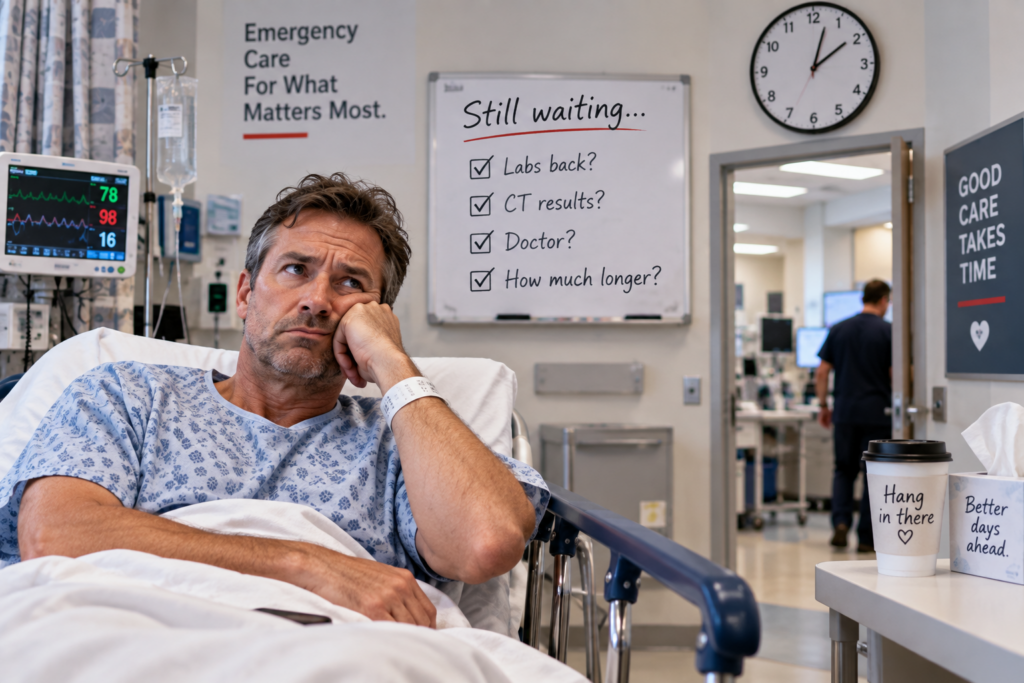
Waiting for unnecessary test results can be very frustrating.
Number Seven: Bring information that will help us. Know when your symptoms started in standard time units. Months, weeks, days, hours.
Symptoms that started after lunch cannot be standardized in a way that makes meaningful use of it. Diseases follow patterns. Chest pain you have had over the last few hours is far more likely to be a heart attack than pain you have had for the last six months.
We need to know the timeline. Also, know your medications, your doctors, allergies, and your major medical problems. Having these details handy can speed up the process.
Take pictures of your medicines to keep on your phone if that helps.
Number Eight: Don’t hide information because it is embarrassing. Drug use. Alcohol. Pregnancy possibility. Sexual history. Medication misuse. Psychiatric symptoms. We won’t hear anything we aren’t prepared to deal with. Help us help you.
We Did A Lot For You
Number Nine: “They didn’t tell me anything.” Usually, the Emergency physician didn’t find a life- or limb-threatening condition. Good for you.
But you wanted to know what you have. That’s a very different result from what your emergency room physician is looking for.
I can save your life without knowing what’s wrong with you. However, you wouldn’t want me to wait until I knew what was wrong with you to save your life. Finding out what is wrong with you is a primary care doctor’s job.
After we save your life, I can tell you what you don’t have. I can more often tell you what you don’t have at the end of an ER visit. But if I’m sending you home, that’s a good sign.
Number Ten: Pay attention at the discharge conversation.
We will explain how to proceed.
Whether it is to take a prescription, or to follow up with a specialist, you need to understand our recommendation.
Return instructions.
This is important.
We are not typically ending care just because we did not find an Emergency medical condition.
Sometimes people present early in the course of an illness.
We don’t have enough evidence that something bad is happening now, but that can change.
Therefore, if it does, you should come back.
In Summation
Generally, the best Emergency department visit is a partnership.
Additionally, tell us what happened accurately.
Also, please tell us what you’re worried about.
Help us understand what changed tonight.
Likewise, keep the visit focused when possible.
Finally, before you leave, make sure you understand what happens next.
September 19, 2026
Medical Disclaimer
ERdoc.com provides general health and emergency medicine information for educational purposes only. This content does not provide medical advice, diagnosis, or treatment. It does not create a doctor-patient relationship.
Medical conditions and emergencies require individual evaluation. Always seek advice from a qualified healthcare professional about your specific situation. If you believe you have a medical emergency, call 911 or seek emergency care.
ERdoc.com makes reasonable efforts to provide accurate, current information. However, medical knowledge and recommendations change over time. Use of this website and any third-party links remains at your own discretion.
© William E. Franklin, DO, MBA · ERdoc.com